
Digitalisation of transport infrastructure
Digitalisation of transport infrastructure
Overview
Faced with the challenges of climate change, sustainability and maintenance cost optimisation, transport infrastructure is entering a new era — one defined by digital technologies and digital twins. LAMES is positioned at the heart of this transformation, developing innovative approaches to better understand, monitor and manage infrastructure throughout its entire lifecycle.
The digital twin creates a dynamic virtual representation of an infrastructure, continuously fed by real-world data. While this approach is already widely used in industry, its application to transport infrastructure remains a challenge due to their complexity, extent and lifespan.
Our work aims to adapt this concept to real-world conditions and support its adoption by practitioners, by developing reliable, concrete tools and models that are directly useful for decision-making.
Research themes
Digital twins
Dynamic virtual representations of infrastructure, continuously fed by field data to manage the full lifecycle.
Artificial intelligence
Automated defect detection, prediction of their evolution and predictive maintenance based on mechanical and dielectric behaviour.
Data-driven systemic view
Integration of multi-source data — climate, traffic, territory, equipment, populations — for a systemic understanding of infrastructure.
Experimental platforms
Digital twins of LAMES infrastructure: fatigue carousels, 4D radar, embedded sensors — from design to maintenance management.
Smart and resilient infrastructure
Multi-scale approaches combining observation, modelling and data to better understand physical phenomena — mechanical, thermal, at the surface and in depth — and design infrastructure capable of adapting to environmental change.
The digital twin: a paradigm shift
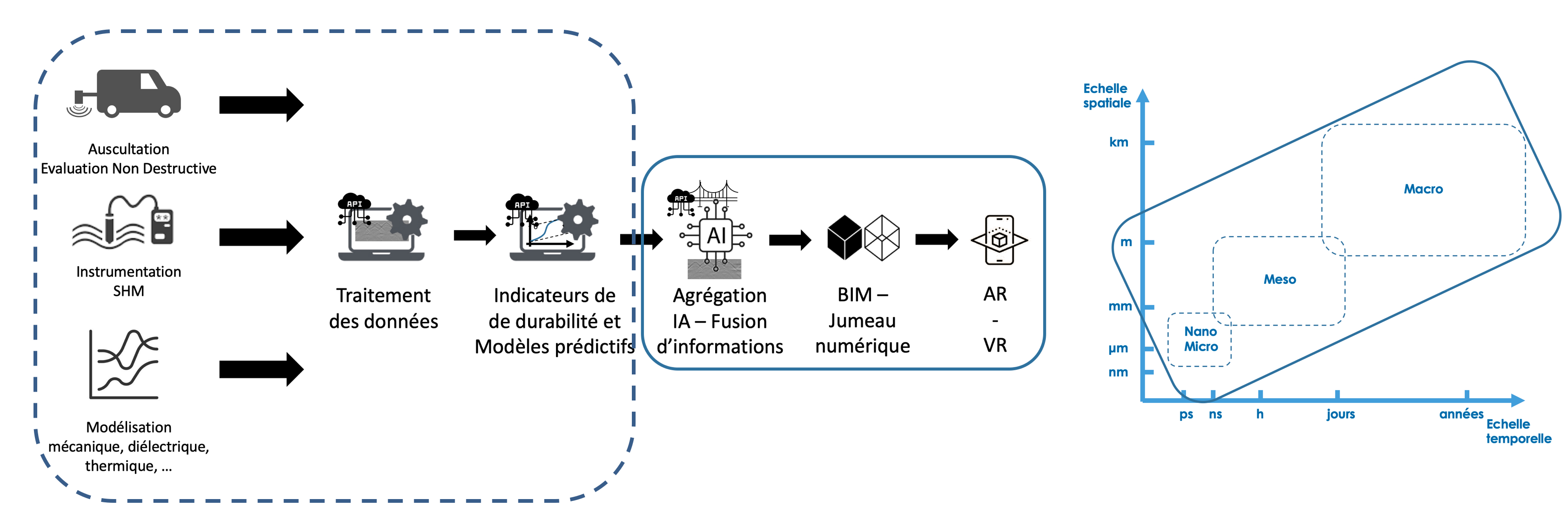
The digital twin represents a paradigm shift in civil engineering. It enables continuous monitoring of structures from design through to inspection for maintenance management, and integrates with LAMES platforms combining experimentation and advanced monitoring technologies — fatigue carousels, 4D radar, embedded sensors, and more.
These systems make it possible to connect data, models and observations to better anticipate infrastructure behaviour. We develop comprehensive digital twins of our experimental infrastructure, integrating data from LAMES platforms.
The ultimate goal is to help design smarter, more durable infrastructure capable of adapting to environmental change — moving from reactive maintenance to predictive maintenance that is more efficient and more sustainable.
Artificial intelligence for infrastructure
A data-driven systemic view
Our digital tools integrate varied data sources to provide a systemic view of infrastructure, essential for anticipating risks and optimising intervention strategies. This multi-source approach covers all factors impacting the infrastructure lifecycle.
Climate data
Temperatures, precipitation, freeze-thaw cycles and extreme events influencing material ageing.
Traffic data
Volumes, loads and passing frequencies to quantify the real mechanical demands on structures.
Territorial data
Geological, hydrological and urban context for territory-specific risk analysis.
Equipment & Sensors
Real-time measurements from embedded sensors, gauges, 4D radar, and on-site onboard systems.
Population data
Usage patterns, densities and mobility needs to prioritise interventions by social impact.
Dynamic survey
Continuous or periodic data acquisition to detect structural changes and trigger alerts.
From data to decision — NDT-Portal
Integrated digital platform
NDT-Portal
All of this work converges towards the development of integrated digital platforms that transform data into concrete, reliable and accessible decision-support tools for infrastructure managers. NDT-Portal is the convergence point of all LAMES digitalisation approaches, from raw data to operational decision-making.

For any enquiry about access, information or collaboration around the platform, contact the project lead at amine.ihamouten@univ-eiffel.fr.
Research projects
Discover LAMES projects
Browse below the LAMES research projects related to the theme Digitalisation of transport infrastructure.